Summer 15% discount on all last year's cocoa butter press models


How to Prepare Cocoa Nibs for Higher Cocoa Butter Yield?

What to Pay Attention to When Preparing Raw Materials for Cocoa Butter Production
Many people who want to produce cocoa butter focus on the machine first.
In our experience, this is where many new users start making mistakes.
Our machines use a special mechanical screw pressing system. They are semi-automatic machines designed to extract cocoa butter by applying continuous pressure. Before shipment, every machine is tested several times. If the motor runs and the pressing system operates correctly, the machine is usually not the problem.
In most cases, the real issue is the raw material.
The most important factor affecting cocoa butter yield is how the cocoa beans or cocoa nibs are prepared before pressing.
You may be a highly experienced chocolate maker. You may also be a farmer with years of experience harvesting, fermenting, and drying cocoa beans. As everyone knows, each of these areas requires its own expertise.
The same applies to cocoa nibs prepared for cocoa butter production.
The drying and roasting process has a direct effect on pressing performance. If the goal is to achieve the highest possible cocoa butter yield, the cocoa nibs should be processed or sourced with that purpose in mind from the beginning.
At first, this may seem like a small detail.
In reality, it affects the entire process.
This is especially important for artisan chocolate makers who want to produce their own cocoa butter.
We often see one producer achieving excellent results with a machine while another producer obtains much lower yields using the same equipment.
The difference is usually the raw material.
The Drier the Cocoa Bean, the Better
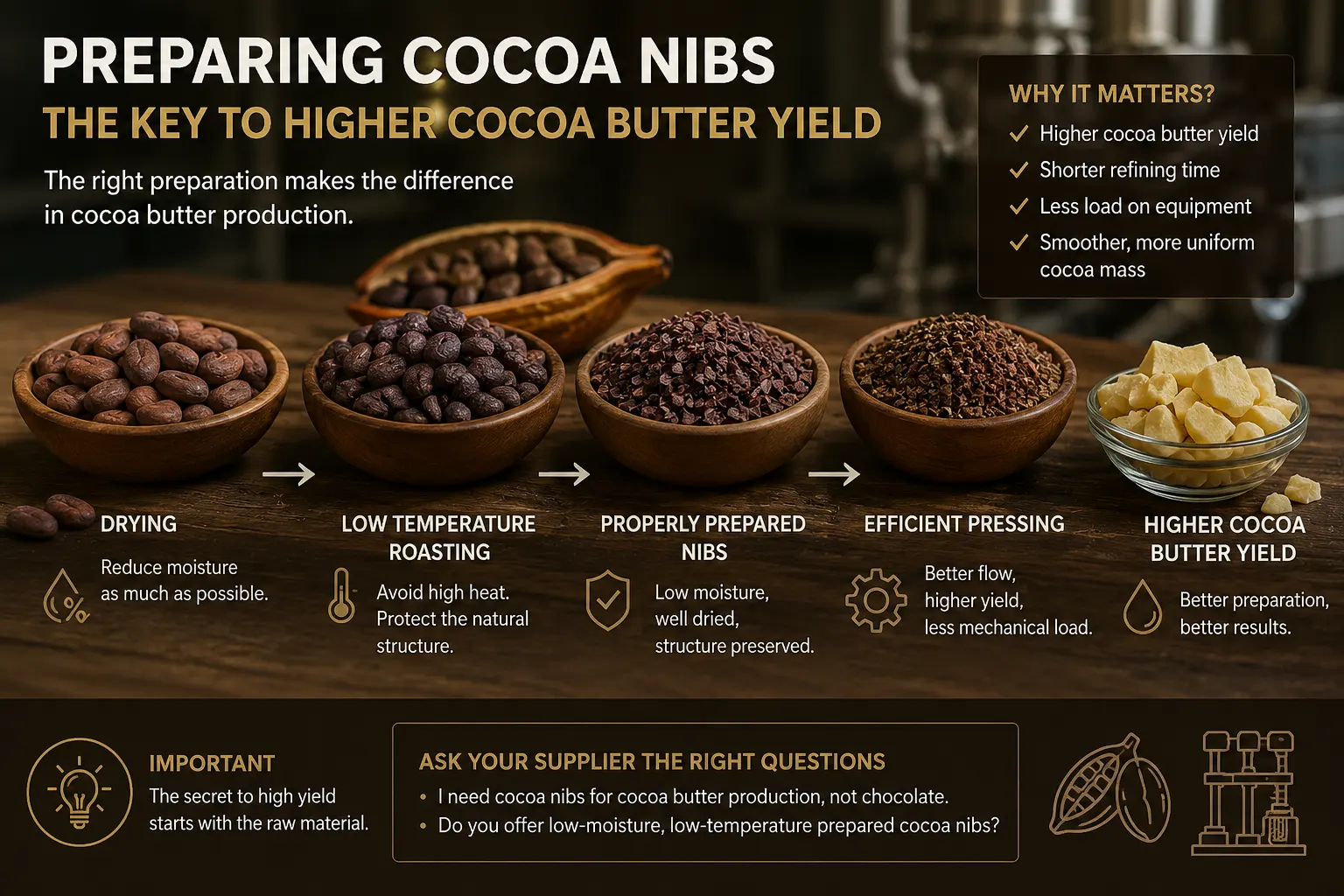
Before pressing, cocoa beans should contain as little moisture as possible.
As moisture increases, pressing becomes more difficult.
Butter extraction may decrease.
The remaining press cake may stay softer than expected.
For this reason, cocoa beans should be properly dried before processing.
Large cocoa processors pay close attention to this step as well.
Freshly harvested beans are first dried to reduce moisture as much as possible before moving to the next stage.
Not Every Roasted Cocoa Bean Is Suitable for Cocoa Butter Production
This is another area where many people make mistakes.
Most videos online focus on chocolate production, not cocoa butter production.
A chocolate maker may choose a heavier roast profile to develop flavor.
That can be beneficial for chocolate.
However, the same approach is not always ideal for cocoa butter production.
When cocoa beans are exposed to high temperatures for long periods, they begin to cook rather than simply dry.
From the outside, the beans may look dry.
But their natural structure changes.
At that point, cocoa butter yield can start to decrease.
Based on our experience, producers aiming to extract cocoa butter should take a more controlled approach.
The goal is not to cook the bean.
The goal is to prepare it for pressing.
Why Low-Temperature Roasting Matters
For cocoa butter production, we generally recommend controlled drying and roasting at lower temperatures whenever possible.
Air-assisted systems can be particularly helpful.
They dry the beans more evenly.
They also reduce the risk of burning or overcooking the cocoa.
This helps preserve the natural structure of the bean.
As a result, the pressing process can produce better results.
Ask Your Supplier the Right Questions
If you do not have your own drying or roasting equipment, you do not necessarily need to perform these steps yourself.
However, you should ask the right questions when purchasing cocoa nibs.
For example:
“I am looking for cocoa nibs for cocoa butter production, not chocolate production.”
“Do you offer cocoa nibs prepared at low temperatures with low moisture content?”
Sometimes a simple question like this can make a significant difference.
Success in cocoa butter production is not determined by the machine alone.
No matter how good the machine is, the desired results may not be achieved if the raw material is not prepared correctly.
That is why the process should always start with the cocoa bean.
Properly dried.
Properly prepared.
Properly roasted cocoa nibs.
Very often, the secret to higher cocoa butter yields starts right there.

