Year-End Special: 5% Off All Cocoa Butter Press Models


How to Install, Clean, and Operate a Cocoa Butter Press

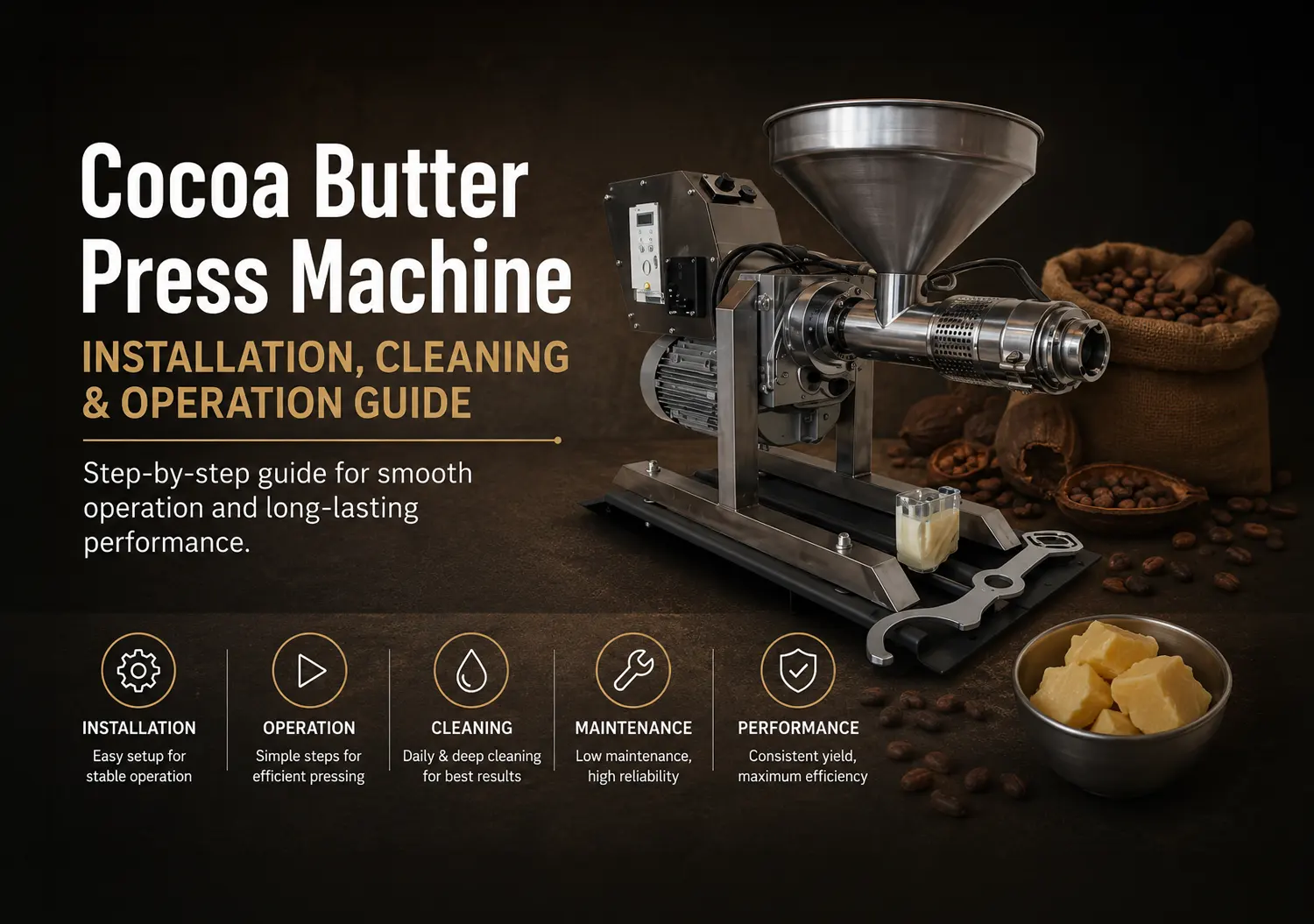
Cocoa Butter Press Machine Installation, Cleaning, and Operation Guide
Many people who plan to produce their own cocoa butter believe that operating a cocoa butter press is difficult.
In reality, that is rarely the biggest challenge.
Over the years, we have learned one simple fact.
Preparing the cocoa nibs correctly is usually far more important than operating the machine itself.
Once the raw material is properly prepared, using a cocoa butter press becomes a straightforward process.
In this guide, we will explain the basic steps for installation, daily cleaning, and normal operation.
What to Check When Your Machine Arrives
When your machine is delivered, the first step is to inspect it carefully.
Check whether any damage may have occurred during transportation.
Inspect the electrical control panel.
Check the cable connections.
Look over the machine for visible dents or impact marks.
Shipping damage is uncommon, but taking a few minutes to inspect the machine is always worthwhile.
Every machine is fully tested before leaving our factory.
Even so, checking everything after long-distance transportation is a good habit.
Next, place the machine on a flat and solid surface.
This is important because the pressing forces must be transferred evenly to the floor during operation.
Perform an Empty Test Before the First Run
One of the most common mistakes new users make is filling the machine with cocoa nibs immediately.
We do not recommend this.
Instead, perform a short empty test first.
Connect the machine to the power supply without adding any cocoa nibs.
Start the motor.
Watch the screw rotate smoothly.
Listen for any unusual sounds.
If everything operates normally, you are ready for the next step.
The entire check only takes a few minutes, but it can help prevent unnecessary problems later.
Why Is Preheating Necessary?
This part is sometimes misunderstood.
The purpose of preheating is not to heat the cocoa nibs.
Its job is to prepare the press head, where the pressed cocoa cake exits the machine.
A properly heated press head allows the cake to leave the machine more easily and helps maintain stable operation.
Under normal conditions, preheating the press head to approximately 100°C (212°F) for 15 to 30 minutes is usually sufficient.
If the workshop temperature is very low, the heating time may need to be extended.
Customers operating in colder regions, especially Northern Europe, often choose a slightly longer preheating period.
Starting the Pressing Process
Once the inspection and preheating steps are complete, production can begin.
Start the system using the motor drive.
Set the desired operating speed.
Then pour the cocoa nibs into the feed hopper.
As the machine runs, the screw moves the cocoa nibs toward the pressing section.
No manual intervention is needed during this stage.
After a few minutes, the first cocoa press cake will begin to appear at the outlet.
Shortly afterward, cocoa butter will begin flowing from the extraction holes.
This indicates that the process is running normally.
What Do the Nozzles Do?
Many customers ask about the purpose of the interchangeable nozzles.
Their function is simple.
They control the compression at the cocoa cake outlet.
Increasing compression can improve butter extraction.
However, there is no need to rush.
When starting production, avoid installing the smallest nozzle immediately.
Allow the machine to stabilize first.
Observe the butter flow.
Then select a more suitable nozzle if additional compression is needed.
From our experience, this gradual approach usually delivers better results.
Why Is Daily Cleaning Important?
Cleanliness is essential in cocoa butter production.
Never leave cocoa material inside the machine after production is finished.
Remaining cocoa cake can harden over time.
That can make the next production run more difficult.
After production, clean the outlet section.
Remove the nozzle.
Clear away any remaining cocoa cake.
Check the feed hopper as well.
These steps usually take only a few minutes but help maintain reliable machine performance.
When Should You Perform Deep Cleaning?
Daily cleaning and deep cleaning are not the same.
Daily cleaning should be carried out after every production run.
Deep cleaning depends on how often the machine is used.
It is especially recommended when switching between different types of cocoa.
This helps prevent residue from one batch from mixing with the next.
During deep cleaning, inspect the cocoa butter drainage holes carefully.
Make sure they are completely open.
If any holes are blocked, clear them using compressed air or a long cleaning needle.
Keeping these passages open helps maintain consistent butter flow and hygienic operation.
Is Maintenance Difficult?
Not at all.
The system is designed to be simple.
One of the biggest advantages of mechanical screw press technology is its low maintenance requirement.
There are no complex hydraulic units.
There are no high-pressure hydraulic oil systems.
Routine maintenance mainly consists of regular cleaning.
Depending on production hours, the bearing grease should be renewed approximately every six to twelve months.
With proper cleaning and basic maintenance, the machine can operate efficiently for many years.
Conclusion
At first, operating a cocoa butter press may seem complicated.
In practice, the process is quite simple when each step is followed in order.
Inspect the machine.
Complete the preheating process.
Feed the cocoa nibs.
Allow the system to reach stable operation.
Clean the machine thoroughly after production.
That is the basic workflow.
Our experience over many years has shown the same result time and again.
Properly prepared cocoa nibs and a clean, well-maintained machine make cocoa butter production both efficient and reliable.

